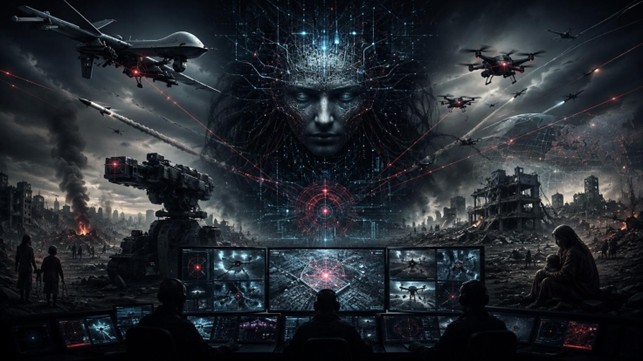
“I know not with what weapons World War III will be fought, but World War IV will be fought with sticks and stones.”
Albert Einstein
Humanity has always had choices in conflict: to negotiate, to coexist uneasily while continuing dialogue, or to fight to kill. In today’s geopolitical climate, the last option appears to dominate. Diplomacy has receded so far from public discourse that it is often soldiers-not statesmen-who remind the world of its necessity. The Doomsday Clock, updated in January 2026, stands at 85 seconds to midnight, signalling humanity’s proximity to self-inflicted annihilation. With autonomous weapons accelerating the kill chain and multiple conflicts unfolding simultaneously, mutually assured destruction feels less like a theoretical construct and more like an impending reality.
A recent thousand-word post by Alex Karp, Co-founder of Palantir, went viral on X, amassing over 30 million views. His 22-point manifesto calls for the rapid expansion of autonomous weapons and deeper collaboration between governments and big tech. More troublingly, it promotes a cultural hierarchy-effectively a form of racism-that must be preserved “at any cost.” Such rhetoric was presumed extinct after the fall of apartheid and Nazism. Yet the ongoing genocide of Palestinians by Israel, supported by the United States, suggests a grim historical regression. In this context, public pronouncements by Karp, Elon Musk, Peter Thiel, Sam Altman, and other tech billionaires become ominous indicators of the direction in which global civilisation is drifting.
Palantir’s Maven Smart System (MSS)-developed for NATO-sits at the centre of the autonomous kill chain deployed in the recent US-Israel assault on Iran, which resulted in the deaths of 180 schoolchildren. That such a supremacist manifesto emerged from the co-founder of a company deeply embedded in Israel’s AI-driven military operations is hardly surprising. Since 2015, Palantir has partnered with Israel to develop autonomous weapons tested and refined through the ongoing destruction of Palestinian life. Yet instead of being ostracised, the company enjoys lucrative government contracts worldwide, including with the US Immigration and Customs Enforcement (ICE), and boasts a market valuation surpassing that of Lockheed Martin.
Israel has built a sophisticated ecosystem of AI-powered tools used in surveillance, apartheid enforcement, and targeted killing. Companies such as Corsight (facial recognition), Cellebrite (device exploitation), and BriefCam (video analytics) form the backbone of this apparatus. AI systems like Habsora and Lavender, used by the Israeli Defence Forces, automate the identification of buildings, infrastructure, and individuals for attack. These technologies are exported globally, integrating seamlessly into end-to-end killing systems.
Palantir and these Israeli firms are not anomalies. The “big five” US tech companies, in partnership with the Department of Defense, contribute to AI-driven warfare through cloud infrastructure, computing power, analytics, and targeting systems. Anthropic was recently blacklisted from defence contracts for insisting-mildly-on maintaining safety guardrails before its models are deployed in autonomous weapons. Their request was simply to keep a human in the loop. OpenAI quickly stepped in to fill the void. Anthropic is no moral outlier; its models already operate within the Maven Support System, and its objections applied only to surveillance of US citizens. For the rest of the world, it seems, anything is permissible.
History shows that war accelerates technological innovation. World War II and ensuing coldwar produced breakthroughs that reshaped modern life: jet aircraft, rockets, radar, GPS, the internet (ARPANET), microwave technology, and computing. With the United States emerging as a global superpower, a military-industrial complex took shape, driving continuous research and development through neo-colonial wars, Cold War interventions, and the “war on terror.” These conflicts were often justified through narratives of protecting women’s rights, human rights, or democracy-narratives that masked geopolitical ambitions.
Among all wartime innovations, none has been more devastating than the atomic bomb. Alfred Nobel believed that the ultimate weapon would deter war by making its use unthinkable. Today, with fission bombs, hydrogen bombs, and intercontinental ballistic missiles, humanity possesses the means to trigger a nuclear winter-a planet shrouded in radioactive dust, sunlight blocked, temperatures collapsing, and life extinguished. “The Day After,” Nicholas Meyer’s film, offers a chilling glimpse of such a scenario.
Despite nine nuclear-armed states, nuclear weapons have been used only once-in the US bombings of Hiroshima and Nagasaki. The Cold War passed without a nuclear incident, even though the US and Soviet Union held 90% of the global stockpile. Apart from the Cuban Missile Crisis, nuclear threats were rare. Nobel’s deterrence theory held, largely because nuclear weapons remained under state control, regulated by international bodies. This structure enabled decades of relative peace and allowed wartime innovations, including nuclear energy, to be repurposed for civilian use.
However, decades of neoliberalism have produced unprecedented wealth inequality and weakened welfare states worldwide. This distress has fuelled a rightward political shift and the rise of despots in electoral autocracies, undermining global institutions under the United Nations. A laissez-faire approach to governance and market development reduced the role of the state in technological advancement. After the Dotcom crash, the US effectively outsourced foundational technology development to private individuals, expecting their products to be available for state use-whether for surveillance, law enforcement, or warfare.
The first casualty of this approach was the rise of powerful social-media corporations whose behavioural-modification tools have destabilised societies, accelerated extremism, and influenced global politics, including events like Brexit. We are now in the second stage, where these same corporations-and a few more billionaires-are leading the weaponisation of AI. As Karp’s manifesto suggests, the era of nuclear deterrence has given way to AI deterrence. The critical question is: Who controls this new deterrence? If the answer is tech billionaires, humanity is heading toward apocalypse.
Technology has always shaped warfare. From fistfights to stones, knives, bows, guns, and bombs, each innovation increased kill efficiency and distance. Modern warfare no longer requires line-of-sight; targets are identified and destroyed impersonally. With AI, the kill chain is automated and premeditated, with minimal or no human involvement. No one is safe, and these technologies can be acquired cheaply by anyone.
Human evolution is rooted in natural selection and competition for resources. Yet societies were expected to transcend this through cooperation and global governance. Historically, the weaponisation of technology remained under state control, preventing catastrophic misuse of chemical, biological, or nuclear weapons. But the current trajectory-embedding AI as a decision-making layer atop conventional weapons-is perilous and demands international resistance. Allowing tech billionaires to dictate global order risks destroying the only known habitable planet. They may build interstellar escape vehicles or a modern Noah’s Ark. For everyone else, there is only one universe.