
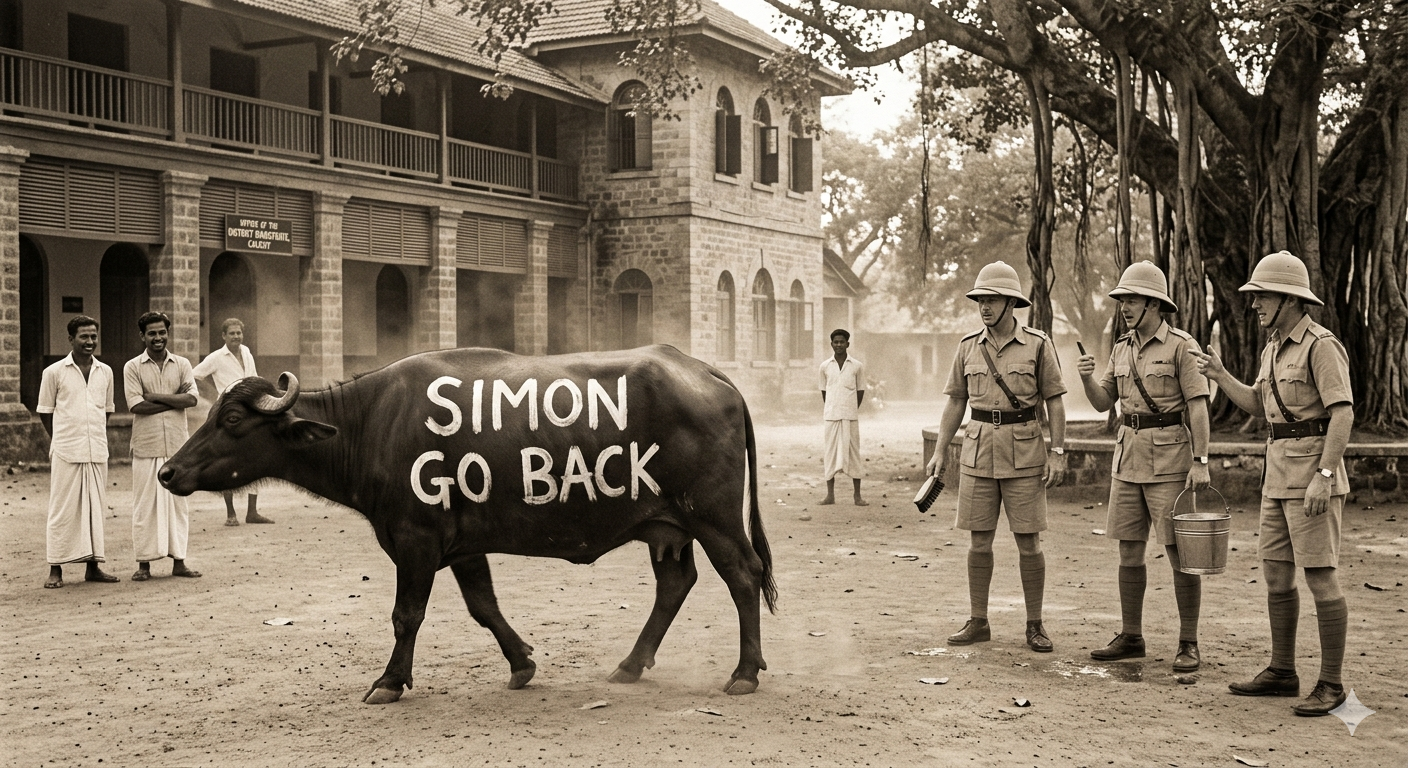
CALICUT BUFFALO
When we talk about political resistance, we usually picture grand oratory, salt marches, or intense negotiations in smoke-filled rooms. But today, I want to talk about a member of the Indian independence movement who didn't hold a title, didn't give speeches, and—quite frankly—was mostly interested in finding a nice patch of grass. I'm talking, of course, about the Calicut Buffalo.

To understand the buffalo, we have to understand the provocation. In 1928, the British government sent over the Simon Commission to figure out the future of Indian constitutional reform. There was just one tiny, glaring oversight: the commission, tasked with deciding the fate of India, had zero Indians on it. It was a bit like a group of cats getting together to write a bill of rights for mice. Naturally, the response was immediate. From Nehru to Jinnah, the message was unanimous: "Simon, Go Back." But the British weren't exactly fans of feedback. In Calicut, as everywhere else in the country, they did what empires do—they banned meetings, banned protests, and effectively tried to delete the "Go Back" from the dictionary.
This is where the people of Calicut proved that you can't out-legislate creativity. They realized that while a human protester could be arrested for carrying a sign, a female buffalo is much harder to cross-examine. Suddenly, a buffalo would wander into the compound of a government office or the police station. Painted across its side in bold letters were the words: SIMON GO BACK. The police were stuck in a slapstick routine. They'd have to stop their official duties, grab some soap and brushes, and give the buffalo a scrub down before shooing it away. But an hour later? There she was again, freshly painted, wandering back into the administrative buildings like a four-legged billboard. I love the official police records from that time. They wrote, with what I imagine was a very British sigh: "The buffalo has no sense of where it is wandering into."

Now, we laugh, but there is a profound lesson here about the resilience of dissent. When the state suppresses the press, when social media becomes a minefield of communal tension, and when traditional platforms for free speech are squeezed shut, the human spirit doesn't just give up. It finds a "walking wall." In 1928, it was a buffalo in Calicut. Today, we face similar pressures to stay silent on values like secularism, federalism, and equality. Looking at the world today, I wonder if it's time to revisit the Calicut Strategy. We see cows wandering our streets every day—they are practically a permanent fixture of our urban landscape. Imagine if these "holy cows" became the new medium for graffiti art. If they wandered through our villages with words like "Democracy" or "Fraternity" painted on their hides, what would the authorities do? It's a bit of a legal conundrum. Can you book a cow for treason? Can you arrest a heifer for advocating for the basic structure of the Constitution?
The buffalo of Calicut reminded the British that you can silence a person, but you cannot silence the environment itself when a population is determined to be free. So, as we discuss the challenges to our democracy today, let's remember the buffalo. Let's keep our protests creative, our spirit resilient, and—most importantly—our "walking walls" moving. Because if a buffalo in 1928 "didn't know where it was wandering," maybe we should be just as fearless in wandering into spaces where we aren't invited, carrying the message of freedom. In doing so, the people of Calicut and their bovine accomplice were unwittingly practicing Henri Lefebvre’s ideas on the occupation of public space and the right to the city, proving that sometimes the best theory is written not in books, but in hoofprints on colonial grass.